Chiang Mai Mountain Trips 2026: Doi Inthanon, Elephant Camps and Coffee Villages Explained
Chiang Mai is ringed by mountains, with the city at about 310 metres and Doi Inthanon to the southwest the highest point in Thailand at 2,565 metres. Mountain trips split into 3 main routes: Doi Inthanon National Park, the animal protection camps around Mae Taeng and Mae Sa, and the coffee villages in the hills to the east, each 1 to 2 hours out by road.
The 3 routes lie in different directions and cannot be combined in a day. Doi Inthanon sits 100 km to the southwest, the elephant camps cluster 40 to 60 km north, and the coffee villages spread 40 to 50 km east. One day each covers all 3 in 3 days.
2026 park fees and hours: 300 baht for Doi Inthanon
Doi Inthanon National Park charges foreign visitors about 300 baht, half price for children, and opens roughly 05:00 to 18:00; Doi Suthep-Pui National Park about 200 baht; Bhubing Palace about 50 baht, 08:30 to 16:30. Waterfalls and trails mostly open 08:00 to 17:00. Fees and hours can change, so confirm the park's official notice.
Altitude and temperature: about 10°C cooler than the city
The Doi Inthanon summit stands at 2,565 metres and averages about 10°C below central Chiang Mai year-round, with early mornings from December to February often between 0 and 8°C and frost on a few dates. Mae Kampong and Mon Cham sit at about 1,300 metres, roughly 5°C below the city. A jacket and long trousers are advisable. Check the day's forecast first.
Seasons: visibility is worst in the February to April haze
November to January gives the best mountain conditions, with little rain and clear views. In the February to April haze season visibility often drops below 3 km and viewpoints give little away. From May to October the roads are slippery and some trails close, with viewpoints restricted when waterfalls run high. Confirm trail status against the park notice.
Reaching the Chiang Mai mountains: 4 options and what they cost
No public transport runs directly into the hills, so access is by day tour with transfers, charter car, self-drive or chartered songthaew. The roads have many bends and some gradients over 15%, and surfaces are slippery in the rainy season. Confirm quotes against each operator's notice.
Day tours with transfers: 1,000 to 1,800 baht per person
A Doi Inthanon day tour runs about 1,000 to 1,800 baht per person including transfers, lunch and a guide, excluding the park fee of about 300 baht, with hotel pickup mostly between 07:00 and 08:00 and a return around 18:00. Elephant camp half-days run about 1,800 to 2,800 baht per person. Confirm quotes and inclusions with the operator.
Charter cars: about 1,800 to 2,500 baht for 8 hours
A 4-seat charter runs about 1,800 to 2,500 baht for 8 hours including fuel and park parking but excluding entry fees, with a mountain-road surcharge of about 300 to 500 baht common for Doi Inthanon. Stops and timings are chosen freely, which suits older travellers and small children. Confirm the quote when agreeing it on the day.
Self-drive: car rental at 1,000 to 1,500 baht a day
A small car runs about 1,000 to 1,500 baht a day against a credit card, and an international permit is required. Chiang Mai to Doi Inthanon is 100 km and about 2 hours one way, with the last 20 km a continuous series of bends. Mountain filling stations often sit more than 30 km apart, so fill the tank before climbing. Confirm rates and insurance terms against each shop's notice.
Chartered songthaews: 1,200 baht a half day, 2,000 baht a day
A red songthaew charter runs about 1,200 to 1,500 baht for a half day or about 2,000 to 2,500 baht for a full day, carrying 6 to 8 people, which suits hill villages within an hour such as Mae Kampong or Mon Cham. The rear is open-sided and cold at altitude, so a jacket helps. Confirm the fare before boarding.
Chiang Mai's mountains in 2026: 9 routes explained
These are ordered by Doi Inthanon, the northern camps and the eastern hill villages, each with fees and drive times. Fees and access can change, so confirm the park and operator notices.
Doi Inthanon summit: Thailand's highest point at 2,565 metres
The Doi Inthanon summit stands at 2,565 metres, with a marker and a short boardwalk at the top, surrounded by mossy forest that stays humid year-round. The summit car park is 100 metres on foot from the marker. The park fee of about 300 baht covers every stop inside.
Hours run roughly 05:00 to 18:00. Early mornings from December to February often sit between 0 and 8°C, and the car park is commonly full around 07:00 on holidays. The summit area is small and about 20 minutes is enough. Confirm fees and hours against the park notice.
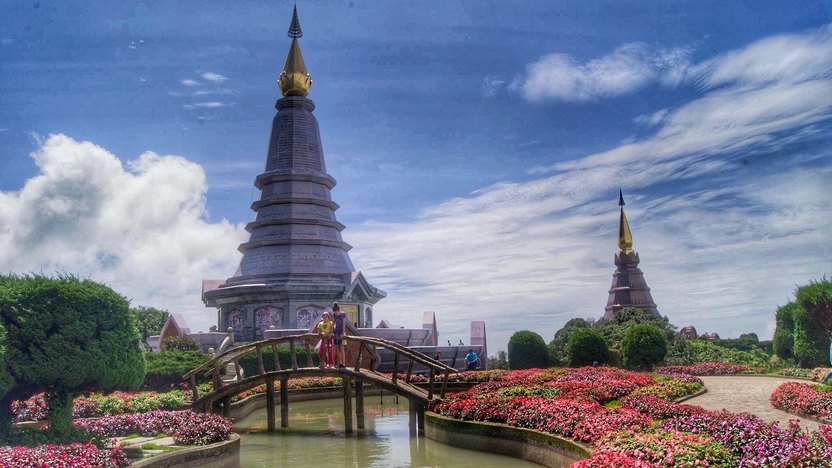
The twin pagodas: royal stupas at 2,200 metres
The twin pagodas stand about 4 km below the summit at roughly 2,200 metres, built in 1987 and 1992 for the king's and queen's birthdays, each about 60 metres high, set among landscaped alpine gardens.
The two sit about 500 metres apart on foot with a 40-metre height difference, served by a lift. The terrace faces the valley and on clear days reaches plains 30 km away, while haze-season visibility often falls short of 5 km. Confirm hours against the park notice.
Kew Mae Pan trail: a 2.5 km loop walked with a guide
The Kew Mae Pan trail runs at about 2,200 metres, covering 2.5 km in about 90 minutes, with mossy forest on the first half and open cliff edge on the second. A local guide is mandatory, at about 200 to 300 baht for a group of up to about 10.
The trail is mostly open November to May and closed in the rainy season. The surface is earth, rock and boardwalk, and some sections are under 1 metre wide. Confirm the open period and fees against the park notice.
Wachirathan Waterfall: a 70-metre drop, the park's main fall
Wachirathan Waterfall drops about 70 metres across a 20-metre width, sitting midway up the access road, with the viewing platform 150 metres on foot from the car park. In high water the whole platform is in spray, so a waterproof cover for cameras helps. There is no separate charge beyond the park fee.
Hours run roughly 08:00 to 17:00. Flow is highest from May to October, when access is restricted at times, and drops clearly in the February to April dry months. Confirm access status against the park notice.
Elephant camps: protection-focused sites without riding
Animal protection camps around Mae Taeng and Mae Sa to the north sit 40 to 60 km from Chiang Mai, 1 to 1.5 hours by road, with half-day programmes at about 1,800 to 2,800 baht per person including transfers and a meal, built mostly on observation, feeding and enclosure work.
Practices differ widely between camps, and whether riding and performances are offered is the main test. Before signing up, confirm the programme, the type of animal contact and the daily visitor cap. Confirm prices and programme details against the operator's notice.
Mae Kampong: village coffee at 1,300 metres
Mae Kampong sits about 50 km east of Chiang Mai, 1.5 hours by road, at roughly 1,300 metres, with about 80 households and cafés and guesthouses along the stream, where the streamside seating is the main draw. A waterfall in the village drops about 20 metres.
Entry to the village is free and some car parks charge about 20 to 50 baht. Coffee runs about 60 to 120 baht a cup. The single-lane road through the village backs up from 11:00 to 15:00 on holidays. Confirm fees and hours against the notices on site.
The Mon Cham area: terraced farms and highland views
Mon Cham sits about 40 km north of Chiang Mai at roughly 1,300 metres, a royal-project highland farming area with about 20 hectares of terraces growing strawberries and cool-climate vegetables, harvested November to February. Entry mostly runs about 20 to 50 baht.
Hours run roughly 06:00 to 18:00. The last 5 km climbs steeply and some sections need four-wheel drive, so self-driving is not advisable in the rainy season. A sea of cloud is common between 06:00 and 08:00. Confirm fees and road conditions against the notices on site.
Bhubing Palace: a royal residence on Doi Suthep
Bhubing Palace stands on Doi Suthep at about 1,370 metres, 10 minutes by road from Wat Phra That Doi Suthep, across grounds of about 160 hectares, with the gardens and ponds open and the main building closed to visitors. Entry costs about 50 baht.
Hours run roughly 08:30 to 16:30, with closures during royal use. Shoulders and knees must be covered and shorts and sleeveless tops are barred. Flowering concentrates from December to February. Confirm prices and access against the official notice.
Bua Thong Sticky Waterfall: limestone that can be climbed by hand
Bua Thong sits about 60 km north of Chiang Mai, 1 hour by road, with a drop of about 50 metres over limestone deposits that grip underfoot, so the watercourse can be climbed by hand, with 3 platforms and ropes along the way. Entry is free.
Hours run roughly 08:00 to 17:00. The lower section closes in high water during the rainy season, and conditions for climbing are better in the dry months. Rubber-soled water shoes work; sandals do not. There is no food nearby, so carry water. Confirm access status against the park notice.
What Chiang Mai's mountain trips cost: the price structure
Spending splits into 3 parts: the tour fee, park fees and food. For a Doi Inthanon day trip, the tour plus the park fee comes to about 1,300 to 2,100 baht per person. The ranges below are typical and move with the season, so confirm against each operator's notice.
Tour fees: 1,000 to 1,800 baht for a day trip
A Doi Inthanon day tour runs about 1,000 to 1,800 baht per person, an elephant camp half day 1,800 to 2,800 baht, and a hill coffee village half day 800 to 1,200 baht. Quotes mostly include transfers, lunch and a guide but exclude park and guide fees. Discounts of about 15% are common in the May to October low season. Confirm quotes against the operator's notice.
Park and guide fees: 300 baht plus 300 baht for a guide
Doi Inthanon charges about 300 baht, Doi Suthep-Pui about 200 baht and Bhubing Palace about 50 baht, mostly half price for children and paid in cash at the gate. The Kew Mae Pan guide fee runs about 200 to 300 baht for a group of up to about 10. Confirm fees against the park notice.
Where to stay for the mountains: picking a zone by route
The zone decides the departure time: all 3 routes start from the city, so the old city or Nimman is easiest for pickups, while sunrise in the hills means staying in a village. The city to Doi Inthanon takes about 2 hours, so confirm drive times against the day's traffic.
The old city and Nimman: inside the pickup zone
Most mountain day tours collect from the old city and Nimman between 07:00 and 08:00, so no separate trip to a meeting point is needed. Both zones have the highest density of places to eat and mostly 24-hour convenience stores. The trade-off is that from December to February rates here are the city's highest band. Confirm live rates on your booking platform.
Village stays: morning cloud and lower temperatures
Guesthouses around Mae Kampong and Mon Cham sit at about 1,300 metres, where a sea of cloud is common between 06:00 and 08:00 without an early start from the city. The trade-offs are about 10 to 20 places to eat in each, mostly closing by 20:00, night temperatures about 5°C below the city, and some guesthouses without heating. Confirm hours with each venue.
Sequencing: leave at 07:00, avoid holiday middays
Doi Inthanon works best leaving between 07:00 and 08:00, reaching the summit before 10:00 to beat a full car park on holidays. The single-lane road at the hill coffee villages backs up from 11:00 to 15:00 on holidays, so arriving before 09:00 helps. Confirm trail status against the park notice.
Climate and kit: 0 to 8°C on the summit, bring a jacket and long trousers
Summit mornings from December to February often sit between 0 and 8°C, so a jacket, long trousers and gloves are worth packing. Trails are slippery from May to October, which calls for rubber soles. In the February to April haze, viewpoint trips are better swapped for waterfalls and coffee villages. Mountain filling stations often sit more than 30 km apart, so fill the tank before climbing. Check the day's weather and trail status before setting out.
FAQ
Q. How does a Doi Inthanon day tour compare with self-driving?
A day tour with transfers runs about 1,000 to 1,800 baht per person, excluding the park fee of about 300 baht; a rental car costs about 1,000 to 1,500 baht a day plus fuel, which works out cheaper split 4 ways. The road runs 100 km one way with many bends, so it does not suit first-time riders. Confirm quotes and charges with the operator.
Q. Does the Doi Inthanon summit actually get cold?
Yes. The summit stands at 2,565 metres and early mornings from December to February often sit between 0 and 8°C, with frost on a few dates, while Chiang Mai below is around 15 to 20°C at the same hour. The summit averages about 10°C below the city year-round, so a jacket and long trousers are advisable. Check the day's forecast first.
Q. Does the Kew Mae Pan trail require a guide?
Yes. The trail must be walked with a local guide, at about 200 to 300 baht for a group of up to about 10, covering 2.5 km in about 90 minutes. It is mostly open November to May and closed in the rainy season. Confirm the open period and fees against the park notice.
Q. How can a contested elephant camp be avoided?
The main test is whether riding and performances are offered. Protection-focused camps with no riding, no shows and a programme built on observation and feeding draw least dispute, at about 1,800 to 2,800 baht per person for a half day. Practices differ by camp, so confirm the programme and the type of animal contact before signing up.
Q. How long does a hill coffee village need?
Mae Kampong sits 50 km from Chiang Mai, 1.5 hours by road, and the Mon Cham area about 40 km, 1 hour, with 3 to 4 hours at each leaving a comfortable pace. They lie in different directions, so pairing them in one day is not advisable. Confirm drive times against the day's traffic.
Q. Is the mountain road safe in the rainy season?
From May to October the road is slippery and some trails close, and viewpoints are restricted when waterfalls run high. February to April is the haze season, when mountain visibility often drops below 3 km. November to January gives the best conditions but the coldest summit. Check the day's weather and trail status before setting out.