Hua Hin Attractions Guide 2026: The Station, Santorini Park and the Markets Explained
Hua Hin lies about 200 km from Bangkok, 3 hours by road, and has been a royal summer retreat since the 1920s. Its sights spread along 30 km of coast, with the central ones within 3 km of each other and walkable while the outlying ones need a vehicle. Two days and one night covers the main route.
The sights fall into 3 zones: the station, the beach and the markets in town within a 3 km walk; Maruekhathaiyawan Palace and Santorini Park 15 to 25 km north; and Wat Khao Takiab, the floating market and Sam Roi Yot National Park 5 to 60 km south.
2026 tickets and hours: mostly under 200 baht
The station and Hua Hin Beach are free; Maruekhathaiyawan Palace costs about 30 baht, 08:30 to 16:30; Santorini Park about 200 baht, 10:00 to 20:00; Sam Roi Yot National Park about 200 baht, 08:00 to 16:00. Wat Khao Takiab is free. Prices and hours can change, so confirm each venue's official notice.
Routing: half a day in town, half a day each side
A workable plan spends the first morning on the station and the old street in town, the afternoon running south to Wat Khao Takiab and the floating market, and the evening at the central night market, then the second morning heading north to Maruekhathaiyawan Palace and Santorini Park. Total driving comes to about 60 km. Confirm opening hours on site.
Seasons: rainfall peaks October to December
Hua Hin sits on the west shore of the Gulf of Thailand. January to April is driest, with swell mostly under 0.5 metres; May to September brings occasional showers; October to December is the wettest, with red flags on some dates as swell rises. Peak rates cluster from December to February and over Thai public holidays. Check the month's rainfall forecast first.
Reaching Hua Hin: 4 options and what they cost
Bangkok to Hua Hin runs by minivan, coach, train or charter. Getting around town uses songthaews, tuk-tuks and rented scooters, while the outlying sights need a charter. The peak falls between 17:00 and 19:00, when the beach road is slowest. Confirm fares against current station notices.
Minivans: 2.5 to 3 hours, about 180 baht
Minivans from Bangkok's southern bus terminal run about 30 times a day at 30-minute intervals, first at 05:00 and last at 20:00, taking 2.5 to 3 hours for about 180 baht and departing once 13 seats fill. They terminate near the town's clock tower, 10 minutes on foot from the beach. Confirm fares and departures at the terminal.
Coaches: 3 hours, 180 to 250 baht
Full-size coaches from Bangkok's southern terminal run about 20 times a day, taking roughly 3 hours for 180 to 250 baht, with wider seats and one rest stop en route. The terminus is 5 minutes by road from the town centre, about 60 baht by tuk-tuk. Confirm fares and departures at the terminal.
Train: 4 hours, 44 to 500 baht
About 10 services a day run from Bangkok's Krung Thep Aphiwat station to Hua Hin, taking roughly 4 hours, at about 44 to 100 baht in third class and about 300 to 500 baht in air-conditioned cars. The station sits in the town centre, 10 minutes on foot from the beach. Confirm fares and departures at the station.
Local transport and charters: tuk-tuks 60 baht, charters 1,500 baht a day
Town tuk-tuks do not use meters and short hops run about 60 to 150 baht, so agree the fare before boarding. Songthaews along the main road cost about 20 to 30 baht a trip. A 125cc scooter runs about 200 to 300 baht a day against a passport. A 4-seat charter runs about 1,500 to 2,000 baht for 8 hours. Confirm fares and rates when agreeing them on site.
The 9 Hua Hin sights worth your time in 2026
These are ordered by the town, the north and the south, each with its entry fee and distance. Fees and hours can change, so confirm each venue's official notice.
Hua Hin railway station: a teak station building from 1926
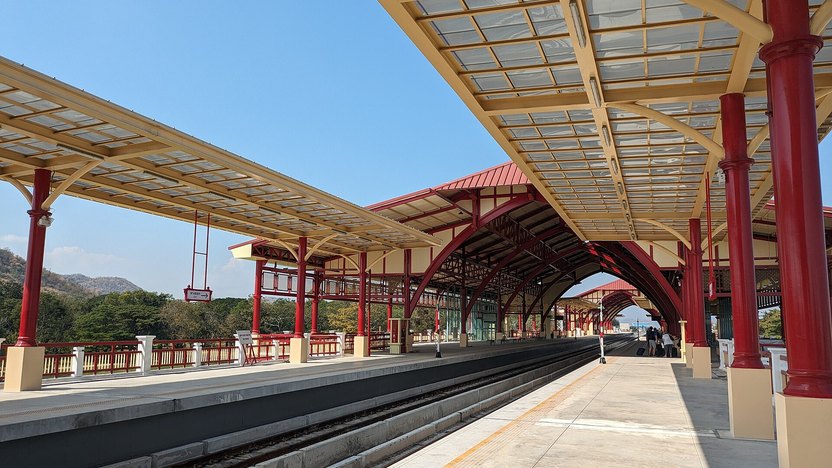
Hua Hin railway station was completed in 1926, with a red-and-white teak station building, and the royal waiting pavilion beside the platform was built elsewhere in 1911 before being moved here in 1968. The station remains in service, with about 10 trains a day calling. Entry is free.
The platform is open all day; keep outside the yellow line and clear of arrival times when photographing. The town clock tower is 10 minutes on foot and the beach 1 km away. A small display area sits inside. Confirm the current rules with station staff.
Hua Hin Beach: 5 km of gently shelving sand
Hua Hin Beach runs about 5 km and 20 to 40 metres wide on a gentle gradient, with water under 1 metre deep often extending 30 metres or more, the northern end against the town and the southern end towards Wat Khao Takiab. About 60 places to eat line the sand, mostly trading to 22:00. Entry is free.
Beach chairs rent for about 100 baht including an umbrella, and 15 minutes of horse riding runs about 300 to 600 baht. Red flags go up on some dates from October to December as swell rises. Confirm prices and the day's flags against the notices on site.
The central night market: 200 stalls from 18:00
The central night market occupies Dechanuchit Road east of the station, opening daily at 18:00 and closing around 23:00, with about 400 metres of road closed and roughly 200 stalls weighted towards seafood and street food at 60 to 250 baht a dish.
Crowds concentrate from 19:00 to 21:30. Seafood is mostly priced on the day's catch, so confirm the unit price and how weight is charged before ordering. The station is 5 minutes on foot. Confirm prices and trading hours against each venue's notice.
Cicada Market: a weekend crafts market
Cicada Market sits about 4 km south of town, mostly opening 16:00 to 23:00 from Friday to Sunday across about 2 hectares with roughly 150 stalls weighted towards crafts, design goods and small stage performances, plus an open-air food court.
Entry is free and some performances are ticketed separately. It is 10 minutes by road from town, and the car park is commonly full after 19:00 at weekends. Confirm trading days and hours against the market notice.
Wat Khao Takiab: 300 metres uphill and a resident monkey troop
Wat Khao Takiab stands on a headland about 5 km south of town at roughly 100 metres, with a standing Buddha about 20 metres high in front facing Hua Hin bay. The climb from the car park covers about 300 metres of stepped uphill. Entry is free.
Hours run roughly 06:00 to 18:00. About 200 wild monkeys live on the hill, so do not feed them or carry plastic bags openly, and keep belongings inside a bag. Shoes come off in the hall and shoulders and knees stay covered. Confirm current hours against the temple notice.
Maruekhathaiyawan Palace: a teak retreat from 1923
Maruekhathaiyawan Palace sits about 15 km north of town, completed in 1923, with 16 teak buildings linked by raised walkways, the whole complex standing about 2 metres above the ground and ventilated towards the sea, making it the most complete surviving teak royal retreat in Thailand. Entry costs about 30 baht.
Hours run roughly 08:30 to 16:30 and it closes on Wednesdays. Shoulders and knees must be covered, shoes come off inside and tripods are barred. A visit takes about 60 minutes. Confirm prices and closing days against the official notice.
Santorini Park: a theme park opening at 10:00
Santorini Park sits in the Cha-am area to the north, about 25 km from Hua Hin and 30 minutes by road, across about 7 hectares built around white-walled, blue-roofed buildings, with a Ferris wheel and several rides. Entry costs about 200 baht and some rides are charged separately.
Hours run roughly 10:00 to 20:00. The park is mostly outdoors and hot at midday, so after 16:00 works better. A sheep farm and several similar parks sit nearby. Confirm prices and hours against the park notice.
Hua Hin Floating Market: 800 metres of boardwalk
Hua Hin Floating Market sits about 6 km southwest of town across about 2 hectares of water, with roughly 800 metres of timber boardwalk and about 100 shops, plus small boat tours at about 100 baht a trip. Entry costs about 50 baht.
Hours run roughly 10:00 to 20:00. Crowds are densest after 17:00 on holidays. It is 15 minutes by road from town. Confirm prices and hours against the venue notice.
Sam Roi Yot National Park: a cave trail with 250 metres of climb
Sam Roi Yot National Park sits about 60 km south, 1 hour by road, where the limestone peaks reach about 605 metres. Its best-known cave holds a royal pavilion built in 1890, lit by a shaft of daylight around midday. The park fee runs about 200 baht.
Hours run roughly 08:00 to 16:00. Reaching the cave means about 10 minutes by boat then a trail covering 250 metres of height change, roughly 30 minutes one way on rock steps that turn slippery after rain. Confirm fees and access status against the park notice.
What Hua Hin's sights cost: the tickets
Spending splits into 3 categories: tickets, transport and rentals. Tickets mostly sit under 200 baht, so the charter is the main cost. The ranges below are typical and move with the season, so confirm at each ticket office.
Tickets: about 480 baht for the 4 paid sights
Maruekhathaiyawan Palace costs about 30 baht, Santorini Park about 200 baht, the floating market about 50 baht and Sam Roi Yot National Park about 200 baht, totalling about 480 baht; the station, the beach, Wat Khao Takiab and the central night market are free. Booths mostly take cash. Confirm prices against each venue's notice.
Transport and rentals: charters 1,500 baht a day, beach chairs 100 baht
A 4-seat charter runs about 1,500 to 2,000 baht for 8 hours and chains either the northern or the southern sights in one go. Town tuk-tuks run about 60 to 150 baht for short hops and scooters about 200 to 300 baht a day. Beach chairs rent for about 100 baht and 15 minutes of horse riding runs about 300 to 600 baht. Confirm costs when agreeing them on site.
Where to stay in Hua Hin: picking a zone by route
The zone decides evening movement: the town centre to walk to the market, the south for beach resorts, the Cha-am area to the north for lower rates. The town to Cha-am takes about 25 minutes, so confirm drive times against the day's traffic.
The town centre: station and market within walking range
Central lodging puts the station, the night market and the northern beach within a 10-minute walk, with about 150 places to eat mostly trading past 22:00, making it the zone that needs no vehicle in the evening. The trade-offs are Hua Hin's top rate band in high season and crowd noise in rooms facing the market. Confirm live rates on your booking platform.
The southern beach and Cha-am: resort facilities and lower rates
Coastal lodging south of town is mostly larger resorts on the 5 km beach, while Cha-am to the north sits 10 minutes by road from Santorini Park with rates mostly 15% to 25% below the centre. The trade-offs are about 30 places to eat in each, mostly closing by 22:00, which means a ride in the evening. Confirm hours with each venue.
Sequencing: outdoor sights in the morning, markets at dusk
Maruekhathaiyawan Palace and Sam Roi Yot National Park both close between 16:00 and 16:30, so they belong in the morning. Santorini Park and the floating market stay open to 20:00, which suits after 16:00. The central night market opens at 18:00 and is tightest after 19:00. Confirm hours on site.
Climate and kit: rainfall peaks October to December
October to December is the wettest stretch, with afternoon showers common, so carry rain gear and keep outdoor stops in the morning. Shade is limited on the beach and in the parks, so a hat and 1.5 litres of water are the baseline. Monkeys live at Wat Khao Takiab, so keep belongings inside a bag. Check the day's rain forecast before setting out.
FAQ
Q. Is Hua Hin workable as a day trip from Bangkok?
Tight. Minivans take 2.5 to 3 hours one way at about 180 baht, so a same-day return spends 6 hours on the road and fits only 3 central sights. The night markets only fill up after 18:00, so one night works better. Confirm departures and fares at the station.
Q. Is there an entry fee at Hua Hin railway station?
No. The station is a teak building from 1926, and the royal waiting pavilion beside the platform can be viewed from outside but not entered; keep outside the platform's yellow line when photographing. The station is still in service and access is controlled when trains arrive. Confirm the current rules with station staff.
Q. How many night markets does Hua Hin have?
Three main ones. The central market opens daily at 18:00 with about 200 stalls; the Cicada Market to the south mostly opens 16:00 Friday to Sunday and leans towards crafts and live music; the Tamarind Market also trades at weekends. Confirm trading days and hours against each market's notice.
Q. How far is Santorini Park from Hua Hin?
About 25 km, 30 minutes by road, in the Cha-am area to the north. Entry costs about 200 baht with some rides charged separately, and hours mostly run 10:00 to 20:00. Confirm prices and hours against the park notice.
Q. Is Hua Hin Beach suitable for swimming?
The beach runs about 5 km on a gentle gradient, with water under 1 metre deep often extending 30 metres or more, and although the water is cloudy the swell is steady. Red flags go up on some dates from October to December as swell rises. Confirm the flags and signage on site before entering the water.
Q. Does Hua Hin suit older travellers or children?
Yes. The town covers about 3 km and works on foot, the beach shelves gently and most sights are on the level. Wat Khao Takiab involves about 300 metres of uphill, and the cave trail in Sam Roi Yot National Park covers about 250 metres of height change, which suits limited mobility less well.